The Noticeboard Before the Group Chat
A neighbourhood noticeboard can connect neighbours beyond a group chat. See how to assess its location, readability and reply route before posting.
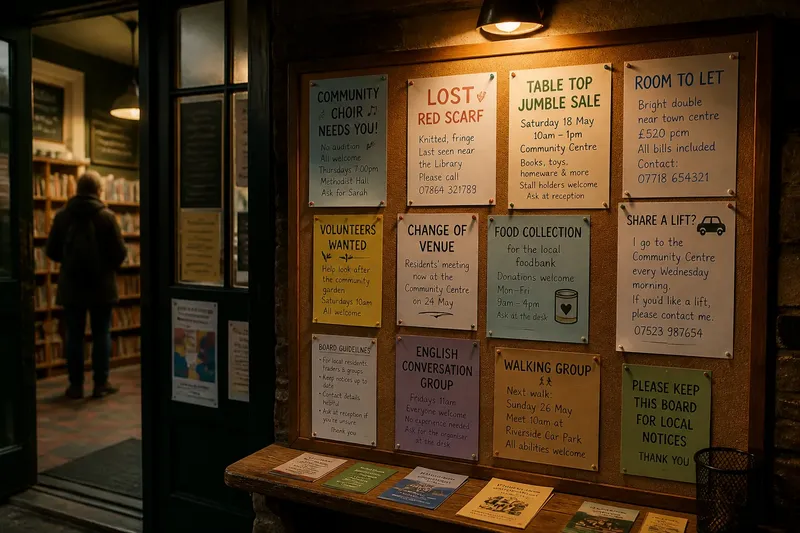
A neighbourhood noticeboard works best when people can reach it, read it and respond without guesswork. Before a phone could ping a group, a sheet in a library, shop window or community hall might announce a lost scarf, a jumble sale or a request for help. Its location decided who was likely to encounter the message during an ordinary day.
Shared notice space
A public noticeboard gives local messages a shared address. Residents can scan announcements from several people and organisations without joining a club or knowing an organiser personally.
Notices might advertise a room, invite singers to a choir, explain a change of meeting place or remind people about a collection. Some boards carry information from a council or housing association; others welcome residents, traders and voluntary groups. Local rules and the person maintaining the display shape what stays visible.
A board differs from a letter delivered to one household. A passer-by can encounter a message without knowing its author, but no board can ensure every resident sees it. Public visibility offers a route to readers, not universal reach.
Location and access
A board reaches people who already pass its spot. One at a library might catch visitors borrowing books or attending a class. A shop-window display could meet people on a routine errand. A board in a shared entrance may serve that building’s residents while remaining invisible to nearby neighbours.
Small physical details matter. A board behind a counter requires permission to approach it. One mounted high may be difficult for a child or wheelchair user to read. Limited opening hours, dim lighting, glare, weather and a crowded corridor can all make a notice harder to use.
These barriers need not be deliberate to affect access. Someone with a regular reason to visit a building has an advantage over a passer-by with no such reason. The setting shapes the audience before anyone reads a word.
Readable invitations
Readers need to know a board exists, reach it and have time to scan it. A display on a familiar route might become part of a daily habit: a glance while waiting for a bus or standing in a queue. A board in a back corridor may be known only to people familiar with the building.
Language and layout matter too. Small handwriting, dense paragraphs, unexplained initials or a single language can put useful information out of reach. A clear heading and short description help readers decide whether to stop. Dates, a specific location and a response method make it easier to act.
A notice can be visible without feeling welcoming. A board full of established groups might say little to someone new. A simple line such as “No experience needed; ask for the organiser at the desk” makes the invitation clearer.
Posting and upkeep
Permission to post might come from a named organisation, a shopkeeper, a caretaker or a volunteer. A board that looks open may still follow unwritten customs about what belongs there.
Clear rules help newcomers know whether they can contribute. A short note could say who may post, whether contact details are needed and whom to ask. Without guidance, established groups might feel comfortable adding notices while a newcomer hesitates. Uncertainty can be a quiet barrier even when nobody has imposed a formal ban.
Space and upkeep shape what people see. If a few organisations occupy the most visible area for a long time, a one-off request could be overlooked. Grouping notices by topic or removing old material can make the board easier to scan, while also giving its caretaker influence over which messages remain visible.
From notice to reply
A useful notice explains what is happening, when and where, and how to respond. A phone number, email address, tear-off tab or instruction to ask at a named desk each gives readers a route back to the organiser.
Paper can be encountered without an account, device or notification. Someone might spot an event while doing something else, copy the details into a diary or mention them to a neighbour. That incidental route suits information that stays relevant for a while. It is less useful when a sudden change needs to reach people quickly.
Say a resident wants to share lifts to a weekly activity at a community centre. They have a notice with the activity name, the day they usually attend and a contact method. They ask the centre’s caretaker to place it near the entrance rather than behind the desk. A visitor passing the entrance can read it and contact the resident. If nobody responds, the resident can ask the caretaker whether regular visitors can see the board, then seek permission to post the notice at a nearby library. The observable result is whether an interested visitor makes contact, not whether every neighbour has seen the request.
Limits of paper
A physical board cannot show who has passed it, understood a notice or tried to respond. A sheet might be covered, removed or damaged, while an old date could remain after plans change. Readers have to judge whether the information still applies, often without an easy way to check.
Boards also favour messages that fit on paper. A short announcement is easy to scan; a complicated discussion or changing set of arrangements is harder to maintain. People who cannot visit the site have no simple way to see the display. Someone who finds written notices difficult to use might need another route, such as asking a staff member or hearing from a neighbour.
A board can be public in principle yet miss people because it sits behind a door, uses unfamiliar language or offers no way to ask a question. Those limits are part of how the message travels.
Board or group chat
A group chat moves notices from a shared physical place to a shared digital space. Members can receive an update without passing a particular shop or hall, and an organiser can correct a time or location without replacing paper. Replies can turn an announcement into a conversation.
A chat has its own thresholds. People need access to the relevant phone or service, an invitation or link, and a reason to join. Messages can get lost among other conversations. Someone joining later might not know the group’s habits, while a neighbour who does not use that platform could miss every update.
The two forms offer different kinds of visibility. A board makes information available to people who encounter a place; a chat sends it to people already connected to a group. Neither automatically includes everyone nearby. A board can offer a doorway to a conversation, while a chat can carry changes that a static sheet cannot easily keep current.
Choosing a noticeboard?
Where should a public noticeboard go?
Choose a place people already visit for an ordinary reason, such as a library entrance, community centre foyer or shop window. Check that it is visible, reachable and open when its intended readers are likely to pass.
What makes a notice easy to read?
Use a clear heading, plain language and space around the text. Put the date, location and response method where readers can find them quickly, and explain abbreviations that may be unfamiliar.
How can a newcomer add a notice?
Look for a posted contact or ask the person responsible for the building or board. If no process is visible, a brief enquiry can clarify whether notices are welcome and whether there are rules about size, subject or removal.
Should a noticeboard replace a group chat?
That depends on who needs the information and how quickly it may change. A board can reach visitors without requiring membership, while a chat can send updates to people already connected; using both offers different routes without assuming every neighbour uses either one.
Practical board checks
- Observe the board from the usual entrance. If arriving visitors can spot it, keep it in place; if it is hidden behind a counter, ask permission to move it nearer the entrance or choose another authorised display.
- Check whether a visitor can reach the board and read its notices. If furniture blocks access or the print is hard to see, clear the obstruction or ask about a more accessible position; if neither is possible, use another permitted site.
- Compare the building’s opening times with the hours intended readers visit. If it is often shut then, seek permission for a window display; if that is not allowed, ask about a public venue open at more suitable times.
- Look for posting rules and a named contact. If both are clear, follow the stated process; if newcomers cannot tell how to contribute, ask the caretaker or organisation to display simple instructions.
- Read a notice for its date, location and response route. If all three are present and still current, readers can decide whether to act; if any is missing or unclear, contact the organiser before relying on it.
- Check whether old notices cover current ones. If outdated material remains and a caretaker is named, ask them to remove it; if nobody is responsible, seek permission before clearing the board yourself.
- Check whether the wording is legible and understandable to its intended readers. If handwriting, initials or language create a barrier, ask the organiser for a clearer version; if a written notice remains unsuitable, offer an accessible alternative such as asking at a named desk.
Everyday public routes
Community communication depends on ordinary routes as much as on the message itself. A well-written notice cannot reach someone who never passes its wall, and a welcoming location cannot help if nobody knows how to contribute. Placement, posting rules and a clear way to respond all shape who gets included.
Before choosing a neighbourhood noticeboard for a local announcement, ask which neighbours already pass the spot and who would need to make a special trip. If the board misses the people who need the message, seek permission to use another public site or pair the paper notice with a group chat. That simple check helps match the route to the readers without assuming one channel suits everyone.